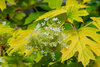
Oakleaf Hydrangea cultivar 'Little Honey' (Hydrangea quercifolia 'Little Honey') photographed in the Keim Hall Courtyard on the University of Nebraska-Lincoln's East Campus in Lincoln, Nebraska.
Oakleaf Hydrangea (Hydrangea quercifolia) is a distinctive deciduous shrub native to the southeastern United States and prized for its four-season ornamental appeal. Large cone-shaped clusters of white flowers emerge in early summer and gradually age to pink and tan, often persisting into winter. The species is named for its large, deeply lobed leaves that resemble those of oak trees. In autumn, the foliage develops outstanding shades of burgundy, red, bronze, and purple before dropping. Exfoliating cinnamon-brown bark provides additional winter interest.
'Little Honey'
A compact selection featuring bright golden-yellow foliage in spring that matures to chartreuse and eventually green as the season progresses. White flower panicles contrast beautifully with the colorful foliage, while fall brings shades of red, orange, and burgundy.
'Alice'
One of the largest and most vigorous oakleaf hydrangea cultivars, growing 10 to 12 feet tall and wide. 'Alice' produces exceptionally large white flower panicles that age to rosy pink and develops outstanding burgundy-red fall color.