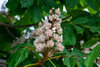
Horse Chestnut (Aesculus hippocastanum) produces showy upright flower clusters in spring that are highly attractive to pollinators and provide ornamental interest before the tree develops its distinctive spiny seed capsules. Photo taken at the Kimmel Education and Research Center in Nebraska City, Nebraska.
Horse Chestnut (Aesculus hippocastanum) is a large deciduous shade tree native to the Balkan Peninsula and widely planted throughout North America for its impressive spring floral display and dense canopy. In late spring, the tree produces upright panicles of white flowers, often marked with pink or yellow highlights, that can reach 8 to 12 inches tall. The flowers attract bees and other pollinators before giving way to distinctive spiny seed capsules containing glossy brown seeds commonly called horse chestnuts or conkers.
Baumann's Horse Chestnut (Aesculus hippocastanum 'Baumannii')
A popular double-flowered cultivar featuring showy white flower spikes that do not produce seeds or messy fruit. Often considered one of the best landscape selections of Horse Chestnut.
Red Horse Chestnut (Aesculus × carnea 'Briotii')
A hybrid horse chestnut known for its striking deep rose-red flower clusters and improved resistance to leaf scorch. Smaller than the species and valued as an ornamental specimen tree.