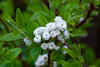
Bridal wreath spirea (Spiraea prunifolia) blooming on UNL’s East Campus in April 2026.
Bridal wreath spirea (Spiraea prunifolia) is a classic spring-flowering deciduous shrub known for its graceful, arching branches covered in clusters of small, double white flowers. Blooming in early to mid-spring, it creates a cascading “bridal veil” effect that makes it a standout in the landscape. The finely textured green foliage provides a soft backdrop throughout the growing season and may develop subtle fall color. This durable shrub thrives in full sun and well-drained soils but adapts to a range of conditions, including clay soils and urban environments.
‘Plena’
‘Plena’ is the most commonly grown form of bridal wreath spirea, valued for its fully double white flowers that create a dense, showy display along arching stems. It offers a more dramatic flowering effect than single-flowered forms.
‘Flore Pleno’
‘Flore Pleno’ is another double-flowered selection similar to ‘Plena,’ featuring abundant, rose-like white blooms and a graceful, arching habit ideal for traditional landscape plantings.